Do free gifts really bring customers back? What the research says
The studies and surveys behind the claims, who ran them, and how far to trust each one.
By the Autora Lab team · Updated November 17, 2026 · 8 min read
Short answer
The printer's quote for Fern sticker sheets is in your inbox. They'd go free into Black Friday parcels, like Priya Shah's order #1043. But they cost money, she won't ask for one, and if you asked her, she'd likely pick money off instead.
So do free gifts work, or is that just something gift sellers say? We make a gift plugin, so we have a reason to like one answer. That's why every number below comes with who found it, when, and its weak spot.
Do shoppers want a free gift or a discount?
When you ask them, shoppers want money off or free shipping. In July 2026, Impact.com asked 1,046 US shoppers which deals they like most for holiday shopping.
46% picked free shipping
Impact.com, 2026
42% picked a percent discount on one item
Impact.com, 2026
17% picked a free gift with purchase
Impact.com, 2026
In that 2026 survey, the free gift came last of five deals, behind flash sales at 35% and bundles at 20%. Impact.com is a marketing company, and these are answers to a question, not purchases.
But look at what they were asked about. A gift with purchase is promised before people buy, so they weigh it against money off, and money off wins. A surprise gift isn't on that list at all, because nobody knows it's coming.
Are shoppers tired of sales?
Many say they are. In November 2024, PYMNTS Intelligence surveyed 2,585 US shoppers who had bought something in the past month.
41% say the number of sales events makes them seem less special
PYMNTS Intelligence, 2024
43% say there are now too many sales to pay attention to them all
PYMNTS Intelligence, 2024
It isn't everyone. In the same 2024 survey, 30% disagreed that sales seem less special, and people still shop the big sales.
But it shows the limit of one more discount: in a busy week, your sale email looks like every other one. A thank-you gift doesn't fight for space in that inbox, because it shows up after the order.
What does research say about surprise gifts and customer loyalty?
The strongest study we found says a small surprise gift makes customers more loyal, if nothing is asked in return. Paul Fombelle, Amie Gustafsson of Karlstad University and three other researchers published it in 2026, in the Journal of the Academy of Marketing Science.
They ran two tests with real shoppers at a grocery and a general goods retailer, plus five smaller studies. Karlstad University says the gifts were things like a pack of coffee or chocolate. Here is what they found:
- Shoppers who got a gift spent more and felt more loyal to the store.
- Cheap gifts worked. BI Norwegian Business School, where one of the authors works, reported in 2026 that a gift worth $0.50 did nearly as well as far more costly ones.
- It worked on new customers and on existing ones.
Two feelings did the work. People felt thankful, which built loyalty. They also felt they owed the store something, more than after a reward they had earned, and that made them spend more right away.
Karlstad's write-up also gives a warning. If gifts come too often, customers may start to expect them, and the gift stops feeling kind.
How big should a surprise gift be?
Small. With new customers, a small gift may even work better than a big one.
In 2024, Carlos Bauer, Fine Leung and Robert Palmatier tested this with one personal care store and more than 6,000 of its customers. Some got a gift worth about $5, and some a gift worth about $20. We read the Academy of Marketing Science's summary, not the full paper.
In that 2024 study, new customers who got the $20 gift were less likely to buy again than those who got the $5 one. The authors link this to suspicion: a big gift from a store you barely know makes you wonder what it wants. The bigger gift only began to work once a customer had been with the store for about three months.
Put next to the 2026 study, the message is the same: how the gift feels matters more than what it costs.
Does it matter if you call it a gift?
Yes, the word itself changes how an extra feels. Zhiying Li and Seunghee Han tested this in 2025 with 342 US adults online, in an imagined purchase rather than real sales.
People imagined booking a boat trip in New York. The extra was either lunch on the boat, which goes with the trip, or a ticket to a big wheel in Times Square, which doesn't.
When the unrelated ticket came as a discount, people felt less like smart shoppers and said they were less likely to buy. When the same ticket came as a free gift, that drop went away.
The lesson costs nothing to follow: call your gift a gift, and say thank you.
What about the repeat-order numbers?
They exist, but they're the weakest numbers in this post. One set comes from Repeat and Stamped, two companies that sell loyalty and repeat-order apps to stores.
In a September 2024 newsletter, Stamped's CEO shared Repeat's numbers for one brand, Lilac St. Its returning customers who claimed a free product as a reward came back within 90 days about 65% of the time.
65% of returning customers who claimed a free product came back within 90 days
Repeat and Stamped, 2024
54% of returning customers who didn't claim it came back within 90 days
Repeat and Stamped, 2024
It's one brand, with no sample size. The free product was a reward people chose to claim, not a surprise. And people who claim rewards are often your most loyal customers, so they may have come back anyway.
An older survey points the same way, just as weakly. In 2012, Harris Interactive ran a survey for IDR Marketing Partners, a marketing firm. About two in five Americans said they were very or extremely likely to buy more often from a website after a free gift.
That's what people said they'd do, and the 2012 report gives no sample size. So no study here proves that a thank-you gift brings back a set share of your customers. The fair claim is smaller: a small surprise makes people feel good about your store, and that feeling helps bring them back.
Discount or surprise gift: which should you use?
Use both, for different jobs. Use discounts to win the sale and a surprise gift to win the next one.
A discount works before the order. Shoppers see it, compare it and buy, which is why they pick it in surveys. A surprise gift works after the order: Priya can't see it before she pays, so it can't change what she spends today.
Put the research together, and the gift needs three things:
- Small. A cheap gift is enough, and a big one can look suspicious to new customers.
- Related to what you sell. This one is our advice, not a study result. A sticker sheet that matches her Fern print reminds Priya of your store each time she sees it.
- Not routine. A gift that comes every time starts to feel like part of the price.
Need ideas that fit all three? See our list of free gift ideas.
If the gift is a coupon for the next order, keep its end date short. Our post on safe thank-you coupons covers Shu and Gneezy's 2010 cafe study, and why a close end date works.
How do you keep a gift a surprise?
Don't announce it, don't give it all year, and don't give the same thing every time.
- Keep it off your product pages, banners and sale emails. Once you promise it, it's a gift with purchase, the deal that came last in the Impact.com survey.
- Give it for a short time, like Black Friday to Cyber Monday, then turn it off with the switch on its row in Gifts > All Gifts.
- Give it once per person. In More options, set How often to "Once per customer", or to "A customer's first order only" to thank new buyers only.
- Change the gift next year. Stickers this Black Friday, something else small next time.
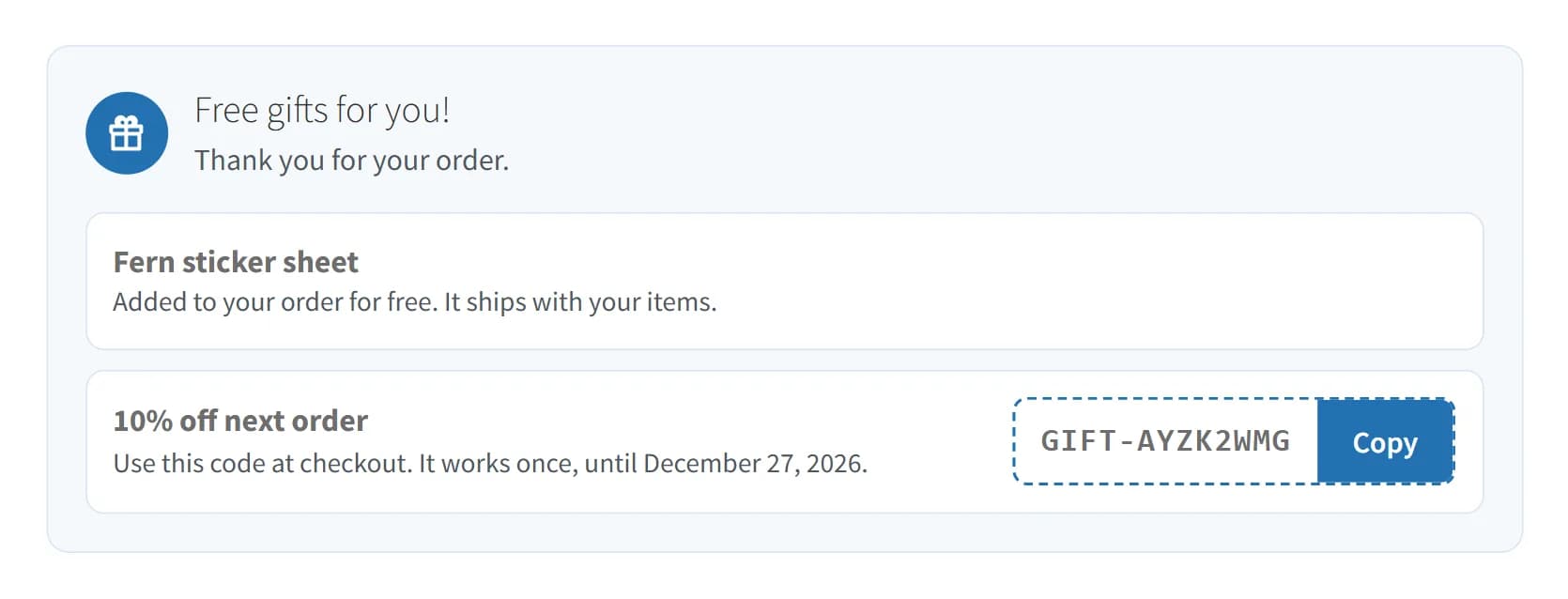
- Let the thank you page say it. The plugin's box is headed "A free gift for you!", or "Free gifts for you!" with two, so the word is already there.
One catch if you take cash on delivery: if the gift is off when you mark those orders Completed, they never get their coupons. The cash on delivery guide says when it's safe.
Post-Purchase Gift adds the gift after checkout. Nothing about it shows in the cart, so there's nothing to announce by mistake.
How to test it in your own store
Run one gift for one sale, then count who comes back. The studies can't tell you about your customers, but your own orders can.
- Keep your Black Friday discount as planned. It wins the sale.
- Add one small surprise gift for the sale's orders. Our setup guide shows each screen.
- After the sale, look at Gifts > All Gifts. Each gift shows how many times it was given, and a coupon gift shows how many codes were used.
- About 90 days later, open WooCommerce > Customers and sort by Orders. See how many of the sale's new customers have ordered again.
To know if your number is good, compare it with the benchmark in our post on turning Black Friday customers into lifetime customers.
Questions store owners ask
Is a next-order coupon a gift or a discount?
A bit of both. It's a surprise when it arrives, but it only saves the customer money if she orders again, so it works more like a discount than a pure gift. None of the studies in this post compared the two. Many stores give both, like Priya's sticker sheet and her 10% code.
Does this research apply to online stores?
Partly. The 2026 study gave its gift at the start of shopping, and the 2025 test was an imagined trip booking. We found no study that tested exactly this: a surprise gift found after paying online. So treat the research as a strong hint, and count your own repeat orders.
Is a surprise gift better than loyalty points?
They do different jobs. Points reward people who already come back, so they help most from the second order on. A surprise gift can work on the first order, before there are any points to earn. You can run both, for example with WooCommerce Points and Rewards for the points.
What gift should I give customers who buy from me often?
Something a little bigger or more personal. In Bauer, Leung and Palmatier's 2024 study, a cheap, plain gift could feel unfair to customers who had been with the store a long time. The authors say a gift picked for that customer can make up for a lower price.
Sources
- Impact.com, holiday shopping survey of 1,046 US shoppers (2026)
- PYMNTS Intelligence, survey of 2,585 US shoppers on sales events (2024)
- Fombelle, Voorhees, Gustafsson, Witell and Gustafsson, The effects of unconditional gifts on customer-firm relationships, Journal of the Academy of Marketing Science (2026)
- Karlstad University, news on the unexpected gift study (2026)
- BI Norwegian Business School, Giving without asking (2026)
- Bauer, Leung and Palmatier, Effects of gifting on relationship performance, Journal of the Academy of Marketing Science (2024)
- Academy of Marketing Science, summary of the Bauer, Leung and Palmatier gift study (2024 study)
- Li and Han, free gift framing in product bundles, Behavioral Sciences (2025)
- Shu and Gneezy, Procrastination of enjoyable experiences, Journal of Marketing Research (2010)
- The National, report on the cafe voucher study (2010)
- Stamped, newsletter with Repeat's free product numbers (2024)
- Total Retail, Harris Interactive survey for IDR Marketing Partners (2012)
We make Post-Purchase Gift, the plugin in this post.